Start Where You Are
Book - $5Second edition - Part V
Keep Growing, Keep What Works
A useful change. A realistic start. Room to adjust.
Choose a recognizable direction, keep helpful practices, make room for enjoyment and maintenance, and finish with a living plan.
Get Part V - $5Read the free sampleOpen experiment planner200 pages / 24 new chapters / $5 USD
Each volume is sold separately. Applicable taxes appear at checkout.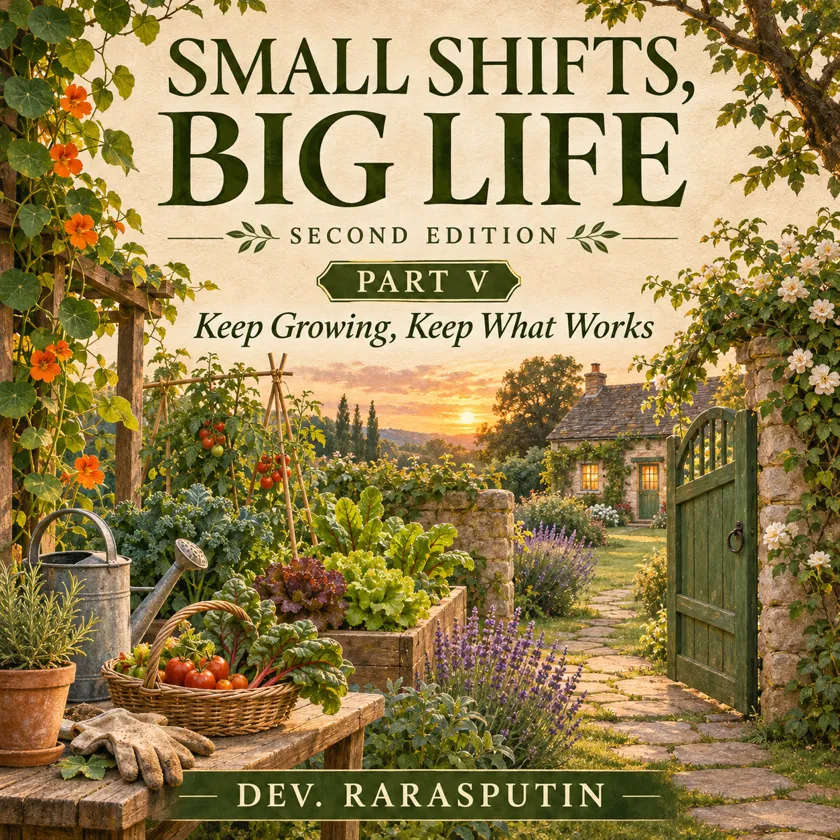
A fresh edition with room for your life.
New lessons, fictional examples, experiments, and usable phrases. You do not need the first edition. Each eight-page chapter moves through understanding, an example, observation, a small experiment, usable language, adaptation, review, and transfer.
The 200 pages include substantial guided writing space. This is a reflection workbook, not 200 pages of continuous prose or a video course. The PDF is not an interactive form.
Companion tool
Plan one useful experiment.
Use one ordinary situation. Keep the action small enough to describe, and choose a review point. No score or daily streak is required.
Entries are not sent to a server. Saving uses this browser's local storage; anyone using the same browser profile may be able to load them. Avoid private details on shared devices. Browser storage can be cleared; keep a download if you need a portable copy.
Inside Part V
Twenty-four practical starting points.
01. Choose a direction you can recognize
A direction becomes usable when it appears in ordinary choices. Name what you want more room for, then describe a small action that would express it. You do not need a complete life plan before choosing the next season's emphasis. Keep room for responsibilities and preferences that may change.
Try: Translate one broad direction into an ordinary visible choice.
02. Define enough for this season
Enough is a practical threshold for a particular purpose, not a total judgment about ambition. Decide what result would meet the current need and what you are choosing not to expand. Review the threshold when conditions change. This gives you a reason to stop improving one area indefinitely.
Try: Write a sufficient result and the optional additions you will leave out.
03. Keep a practice because it helps
A routine deserves its place through its present usefulness, not simply its age or the effort spent building it. Ask what it contributes now and what it costs. You can keep a modest practice unchanged when it serves you. Improvement does not always require adding a new layer.
Try: Review one established practice against its current job.
04. Retain fewer lessons on purpose
After reading many ideas, choose a small set to use. Different practices can remain available without becoming daily obligations. Select what fits a current need, then review it through actual use. This is a decision about attention, not a requirement to forget everything else.
Try: Choose two relevant practices and one reason each earns attention now.
05. Give commitments an ending or review
Some commitments have a clear finish; others need periodic renewal. Name which kind you are making and when its fit will be checked. A review does not guarantee an end, but it creates a chance to discuss changed circumstances. Shared commitments require shared understanding when they change.
Try: Choose one ongoing commitment and identify its finish or review point.
06. Balance maintenance with new growth
Maintenance preserves something useful: relationships, records, tools, or a workable routine. It may not produce a visible new achievement. Include the maintenance a plan actually requires before adding new goals. Otherwise the plan may depend on resources that are already committed to keeping ordinary life functioning.
Try: List the maintenance behind one area of life and what room remains.
07. Let interests remain experiments
You can try an interest without turning it into an identity, purchase plan, or long-term commitment. Choose a modest trial with a clear cost and review point. Notice whether you enjoy the activity itself as well as its imagined result. It is acceptable to stop after learning that it does not fit.
Try: Design a low-cost trial for one optional interest using available resources.
08. Make room for enjoyment without a defense
An enjoyable activity can have value without producing a skill, income, or documented result. Decide how it fits your responsibilities and resources, then let the purpose remain simple. You can choose deliberate practice on other occasions without making every enjoyable hour justify itself as improvement.
Try: Choose one ordinary activity whose purpose can simply be enjoyment.
09. Keep your own definition in view
Other people's milestones can supply ideas, but they do not automatically define your next step. Compare their visible result with your actual interests, constraints, and responsibilities. A definition of progress should be specific enough to guide a choice and flexible enough to change when you learn more.
Try: Write one milestone you value and one visible milestone that is not your present goal.
10. Check what a goal will ask of others
A personal goal can affect shared time, money, space, or responsibilities. Name those effects before treating the goal as solely individual. Discuss the parts that require agreement. This does not mean every preference needs permission, but a plan should not quietly transfer its cost to someone else.
Try: Identify who is affected by a goal and what agreement may be needed.
11. Write a personal operating note
A short note can capture what currently helps you work and live more deliberately. Include a few useful cues, realistic limits, and review questions. It is a provisional aid, not a set of permanent rules about your personality. Revise it when experience stops matching the wording.
Try: Write five practical observations about arrangements that help you now.
12. Use milestones as review points
A milestone can prompt a check of purpose, cost, and next direction rather than automatic expansion. Ask whether continuing serves the original need and whether conditions have changed. You can celebrate a result without promising a larger version. The next step may be maintenance, a pause, or a different project.
Try: Choose a milestone and the questions you will ask when you reach it.
13. Separate renewal from escape
A new plan can be useful, but the appeal of starting again may also hide an unresolved practical issue. Ask what the new arrangement would change and which old requirements would still follow you. You can choose renewal while naming its limits honestly.
Try: Name what a proposed fresh start changes and what it cannot change.
14. Keep progress descriptions factual
A progress note can describe actions completed, information gained, and decisions clarified. It need not announce a transformation in your identity. Include incomplete work and limits when they matter. Factual descriptions make it easier to choose the next step without inflating success or erasing useful effort.
Try: Write a progress note with one completed action and one unresolved issue.
15. Choose an appropriate pace of expansion
When a small practice works, consider whether it needs to grow at all. If expansion serves a real purpose, change one dimension such as duration or scope and watch the cost. Keep the earlier workable version available. A larger plan is not automatically a more valuable one.
Try: Decide whether to maintain, expand one feature, or stop a practice.
16. Make an exit plan for an optional project
Before an optional commitment becomes difficult to leave, identify how to close it responsibly. Preserve necessary materials, tell affected people, and settle any real obligations. An exit plan can make experimentation more honest because you know how to stop without abandoning a shared dependency.
Try: Write the steps needed to close one optional project properly.
17. Review the hidden cost of a useful practice
A practice may help in one way while consuming attention, space, or goodwill elsewhere. Examine both sides without assuming that any cost makes it wrong. You can simplify the practice or renegotiate its shared effects. The aim is a fair decision about the whole arrangement.
Try: List a practice's benefit, cost, and one possible adjustment.
18. Keep a relationship outside the project plan
Shared goals can create useful cooperation, but a relationship also includes interests and contact unrelated to completing tasks. Ask whether every interaction has become a request, update, or performance review. Choose an ordinary form of contact that both people can welcome without an improvement agenda.
Try: Offer one form of contact unrelated to a shared task.
19. Design a review you can stop
A useful review has a purpose and an endpoint. Choose a few questions that lead to decisions, then close the review when those decisions are clear enough. If an issue requires a separate conversation or more information, name that next step. You do not have to solve every uncertainty in one sitting.
Try: Write a review endpoint and the questions needed to reach it.
20. Preserve options without preserving every object
An object or file may represent a possible future activity rather than a present need. Consider what is actually required to keep the option available. You may need a reference note rather than every duplicate item. Respect ownership and relevant retention requirements when deciding what can leave.
Try: Choose one low-stakes collection and identify what preserves the useful option.
21. Build a next-season shortlist
Instead of committing to every future goal, create a small set to consider when the current period ends. Include a reason each goal might matter and the condition that would make it feasible. The shortlist is a thinking aid, not a promise or a backlog of personal failures.
Try: Write three possibilities with purpose and feasibility conditions.
22. Share a method without prescribing a life
When an approach helps you, describe the situation and the feature that seemed useful. Keep the limits visible and let another person decide whether to try it. Your experience is not proof that the method will work for everyone. A useful suggestion can be modest and specific.
Try: Describe one method with its context and a clear limit.
23. Keep a route back to the basics
When a system becomes confusing, return to a few questions: what matters now, what is required, what can you do next, and what needs agreement. These questions can guide simplification without demanding a complete restart. Choose the one that addresses the present problem rather than performing a full ritual.
Try: Use one basic question to clarify a current ordinary situation.
24. Finish with a living plan
A closing plan should remain open to new information. Choose a direction, one or two practices, a realistic review point, and a condition that would justify changing course. Keep the plan short enough to use. Finishing this series does not require you to carry every exercise into everyday life.
Try: Write your direction, chosen practices, review point, and change condition.
Use only what helps.
What does the download include?
The full 200-page PDF and a companion ZIP with a chapter guide, phrase cards, practice-log CSV, and weekly review template. The free sample includes 12 selected pages.
Are these real case studies?
No. All named examples are fictional teaching situations. They illustrate choices without promising a particular outcome.
Must I complete every exercise?
No. Choose a relevant chapter and a proportionate practice. You can adapt, skip, or stop an exercise that does not fit.
How does this differ from the first edition?
This is a newly written five-volume sequence with fresh chapter lessons, examples, and exercises. It stands on its own. The first edition remains a separate product.
Five connected themes